Wind along the route
Wind forecast for your bike route
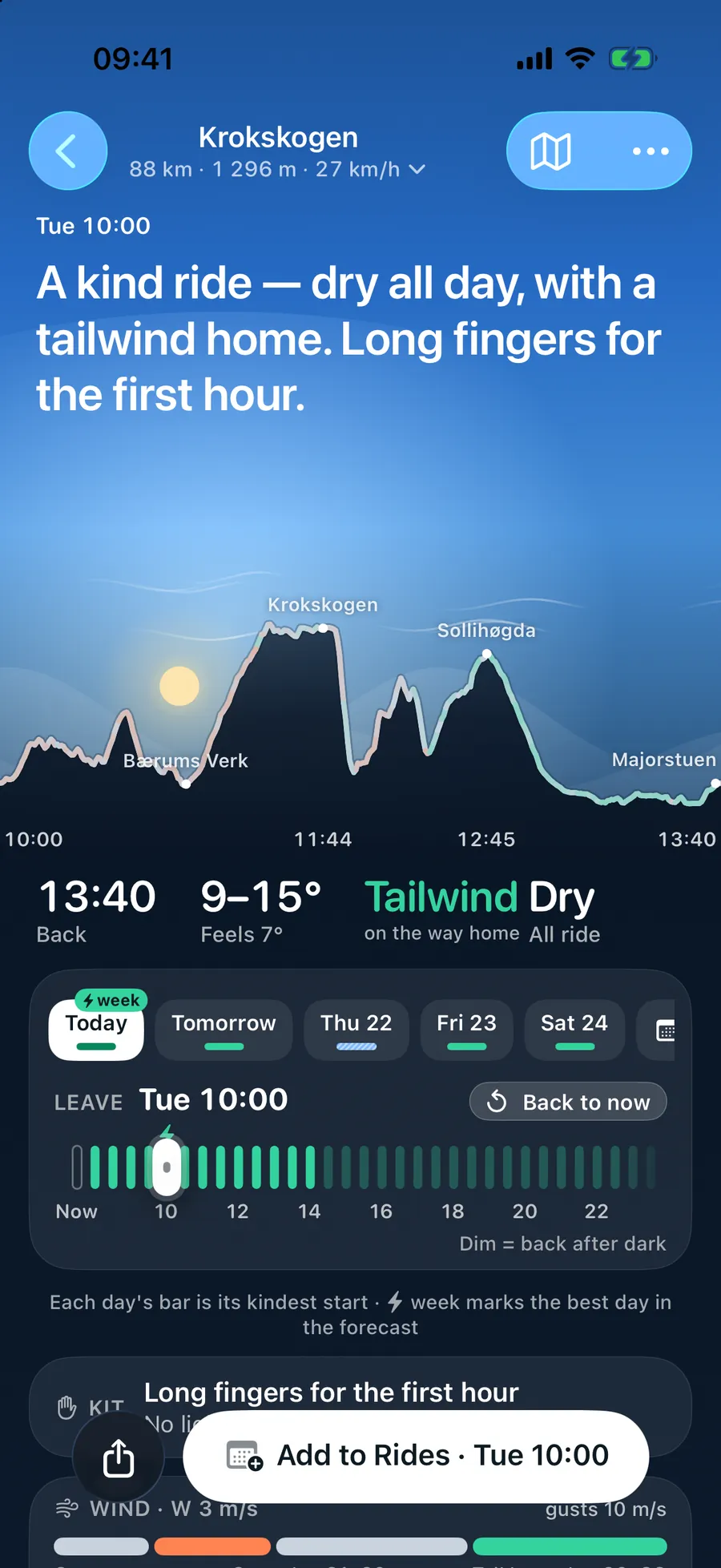
Krokskogen · 88 kmTuesday · 10:00
A kind ride — dry all day, with a tailwind home. Long fingers for the first hour.
- Back at
- 13:40
- Temperature, feels like 7° at the coldest
- 9–15°
- Tailwind on the way home
- Tailwind
- Dry all ride
- Dry
Head, cross and tail, stretch by stretch
A weather app says “westerly, 6 m/s”. Whether that's a friend depends on which way you're pointed. Velvind does that sum for the whole route:
- The route becomes a point every 250 metres, each with the compass bearing you'll be riding on.
- At each point, the forecast wind is read at your arrival time, between the hours either side. Wind is interpolated as a vector, so a breeze swinging through north never averages into a direction it never came from.
- The wind is split into a part along the road and a part across it. Over 1.4 m/s along the road against you is a headwind; the same from behind is a tailwind; the rest is crosswind or calm.
The colours follow: green for a tailwind and nothing else, stone for a crosswind or calm, coral for the stretch you'll spend fighting it. The strip under the horizon names its runs in words, so colour never carries the meaning alone.
The same loop, four hours later
Krokskogen · 88 kmTuesday · 14:00
Dry all day, but a headwind on the way out. Long fingers for the first hour.
- Back at
- 17:42
- Temperature, feels like 8° at the coldest
- 11–15°
- Headwind on the way out
- Headwind
- Dry all ride
- Dry
That's why Velvind reads the wind where you'll be when you're there, not the wind at the start. Kilometre 60 has its own weather.
Your times count the wind
A headwind makes the ride longer, and then the rest of it meets the weather later. So Velvind times the ride in two passes: first in still air, then with the part of the wind along the road. The app counts a quarter of the forecast wind (shelter, other riders and sitting up in a tailwind take the rest), calibrated against real rides. The headwind calculator shows what that comes to on 10 km.
Which way round
In a steady wind, a closed loop's headwind and tailwind cancel out whichever way you ride it. What makes a difference is a wind that turns or builds while you're out, or a shower you can dodge. When that happens, Velvind says if the loop is kinder the other way round. Otherwise it says nothing.
In the app
Read on
Coming to the App Store.
Velvind for iPhone: a paid app, with a week's trial. Leave your email and we'll write once, when it's out.
The planner in your browser. Sign up with Google or email.